
TL;DR: The car wash industry came a long way through 100+ years of evolution. Understanding that progress helps modern detailers (especially mobile operators) see where the industry is heading and where the biggest opportunities sit today.
Before diving into this journey, I needed to zoom out and study the broader car wash industry. The roots, the business models, the economics, and the ecosystem in general. Where it came from. How it grew. And what shaped the businesses in today’s day and age.
I can’t escape my analytical brain. And honestly, I figured you might want to follow along so we can learn a thing or two together.
For this research, I tried something new.
I followed the workflow1 posted by Compound With AI where he provided steps to build your own industry analyst in NotebookLM. I leveraged ChatGPT with the deep research feature to generate the sources based on historical, economic, and industry data. I had never used NotebookLM before and it blew my mind on how good it was.
It only uses your uploaded sources, so it stays grounded and doesn’t hallucinate. I share the notebook link at the end of this post so you can explore deeper or create your own.
Here’s a mindmap produced by the Industry Analyst I created in NotebookLM. At the end of this post I shared the link to the live version where you'll also see other outputs such as a video presentation, slides and a quiz!
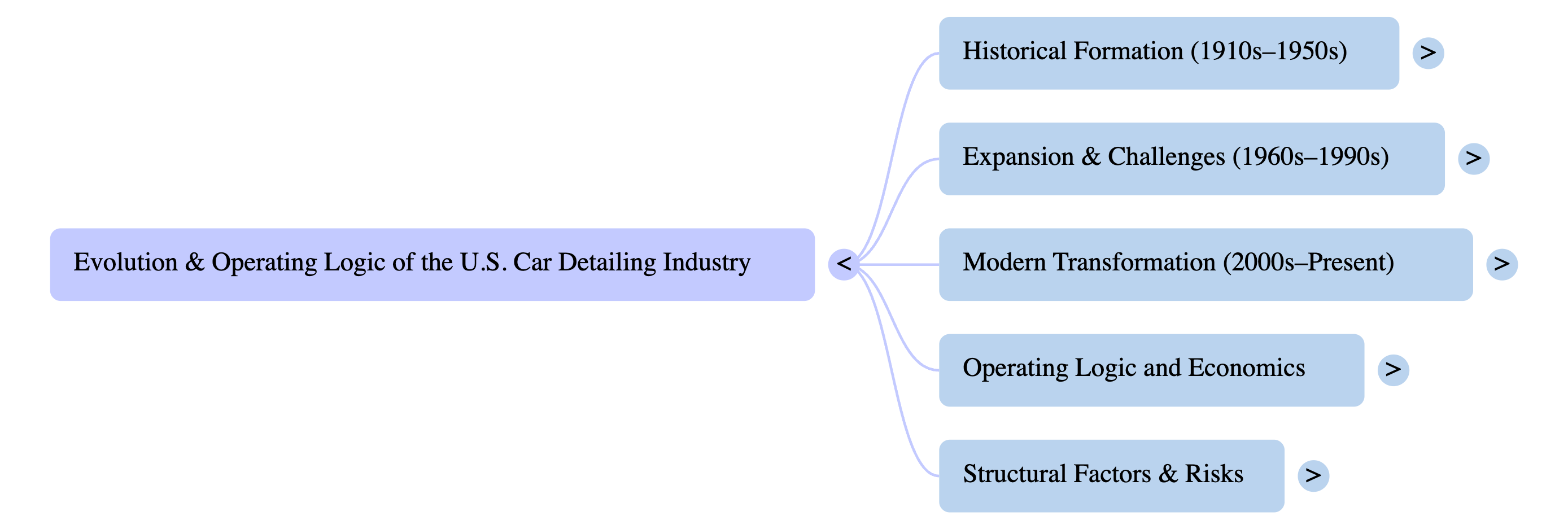
Sit tight, this post has gotten a tad long :) It is distilled version of the research highlighting my personal findings and translated into insights you can actually use or that we will explore more in future articles.
First, A Bit of History (1/5)
As in most industries, the early days of car washing were all labor. Pure, elbow-grease effort. Think crews lined up on each side of a car, wiping and scrubbing as it rolled forward. Almost like an assembly line, but powered by people instead of machines.
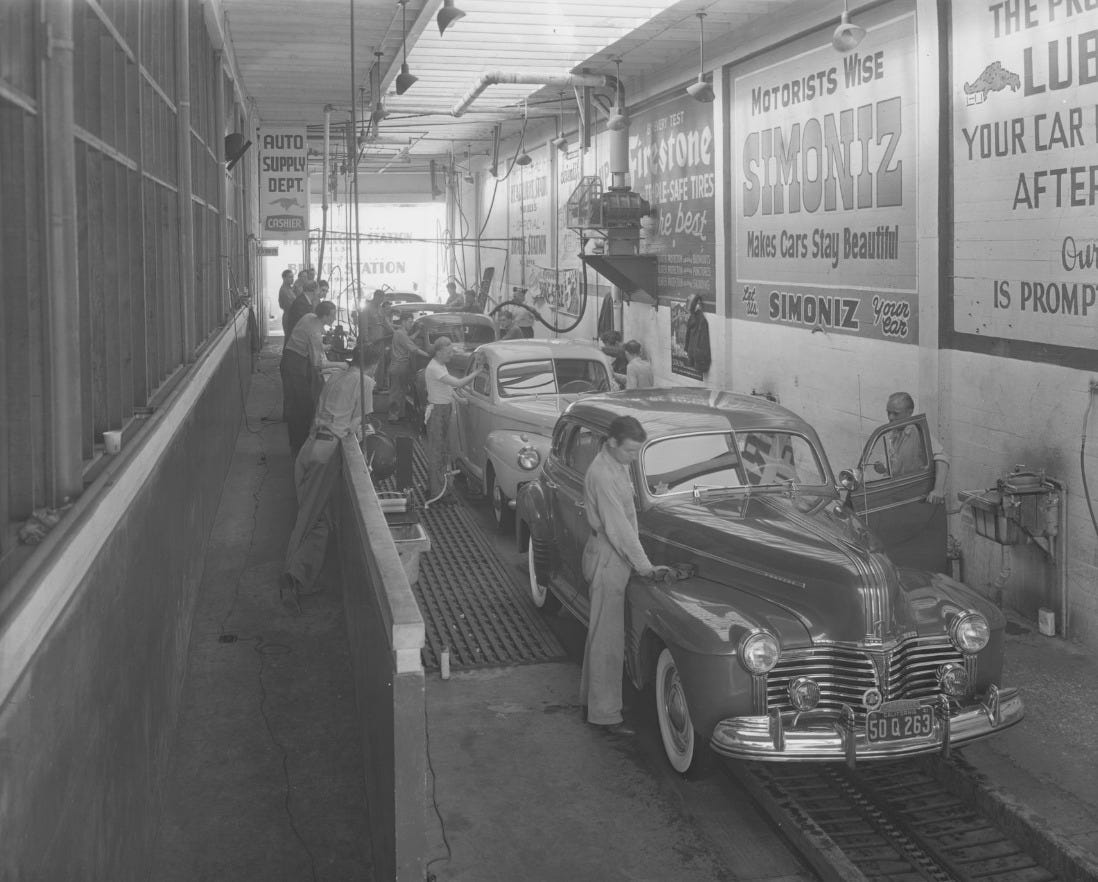
Over time, the same forces that shape every service industry started creeping in: customers wanted speed, operators wanted lower costs, and everyone wanted better margins.
And that slowly pushed car washing toward automation.
If you look through the research, you’ll see the shift happening step by step:
First came simple conveyors. Then pumps and timed nozzles. Then the full tunnel systems with brushes and dryers.
It wasn’t one big invention. It was a long progression of “how do we make this easier and faster?” The introduction of franchises like Minit-Man and the rise of standardized equipment from Dan Hanna Sr. accelerated everything. By the 1950s and 60s, the industry was already chasing throughput over craftsmanship.
Detailing, meanwhile, stayed anchored in the craft-based side of the spectrum. That’s still true today and turned out to be your biggest competitive advantage.
Challenges That Shape the Industry Today (2/5)
As I read through the challenges, some were expected and others were a bit more surprising, but together they paint a clear picture of the headwinds every operator should be aware of.
Weather Volatility
You can plan your week perfectly… and then the weather throws it straight out the window.
Rain, cold snaps, heat waves; Any of these can wipe out days of revenue, especially for mobile detailers who rely on predictable conditions. I put this one first because it really is the biggest wild card you’ll deal with, in my honest opinion.
Economic Cycles
You can tell yourself otherwise, but when budgets get tight, one of the first things people cut is car care. It’s not personal, it’s just how discretionary spending works. Not a surprising challenge, but definitely one you need to factor into your long-term planning.
Labor Cost
This one hits the operators who are scaling, running multiple vans, hiring technicians, or building a small team. Labor costs in the U.S. have been rising for years, and in detailing they typically represent 30–50% of revenue. That’s a huge slice of the pie.
We’ll dive deeper into labor when we break down the numbers from the industry leaders.
Market Saturation
Also not shocking, but it has layers worth paying attention to.
The express wash industry has seen a wave of private equity investment, and that money needs to go somewhere, which means new sites, new tunnels, and more competition for customer attention.
But express washes are a different animal.
They’re real-estate heavy, expensive to build, and more limited by geography. Many markets are now pushing back with zoning issues, environmental concerns, and traffic impact2.
Detailing operators live on the edges of this saturation.
Entry barriers are low, upfront investment is small, and you can move where demand naturally flows. That’s an advantage, but it’s also something to watch, because some big car wash brands are expanding into mobile detailing to capture more of the value chain.
Saturation can be softened in areas where supply and demand stay balanced, but it’s still a trend worth paying close attention to.
Keep these challenges in mind as you plan your business. The goal isn’t to scare you — it’s to give you clarity. Knowing the headwinds helps you build a setup that can handle them.
Modernization Wave (3/5)
The part that impressed me most in the research was just how quickly the industry has modernized after the 2000’s, especially compared to how slow it used to evolve.
Automation took a giant leap. Modern tunnels can run 100–150 cars per hour. Not per day, per hour. Labor per car drops to almost nothing.
Then subscriptions showed up and rewired the whole revenue model. Unlimited wash memberships now make up more than half of revenue for some big chains. It’s predictable. Pretty smart!
The customer experience went digital almost overnight — apps, license plate recognition, frictionless entry, self-pay kiosks. Even a basic $10 wash feels like it has better tech than most independent businesses.
And in parallel, a whole new segment grew: mobile and on-demand detailing. Companies like Spiffy, focused on B2B, use apps and waterless techniques to deliver services wherever the customer is. This segment is projected to grow around 19% a year through 2030.
What this tells us is simple: The expectations around convenience, automation, and subscriptions are rising. Detailers who lean into even small pieces of this: Memberships, digital booking, simple automations, will feel the shift in their business.
Economics Behind It All (4/5)
Here I'll get a bit more into the details, even citing the sources, so you can dig in further if you’d like.
Per MMCG Invest, a national provider of car wash feasibility studies for lenders, investors, and developers, here’s where the U.S. car wash and detailing industry stood at the end of 20243
~$14–15B in annual revenue
~58,000 establishments
No operator holding more than ~5% market share
Translation: the industry is huge, and nobody owns it.
That fragmentation is exactly why small, independent detailers continue to thrive. The market is still very local, very relationship-driven, and very open.
Margins
Margins are where things get interesting.
Automated tunnels, the big, conveyor-driven setups, can hit 40–50% EBITDA when they’re dialed in. That’s the high-volume, high-throughput side of the industry.
Industry-wide net margins settle closer to 20%, which is still solid.
Detailers rarely hit tunnel-level margins (those machines just print efficiency), but the ceiling is higher than most think. When your labor, pricing, and throughput are tight and intentional, the business becomes a lot more profitable than many operators assume.
Capital Intensity
Here’s the biggest difference between “our” side of the industry and the tunnel world.
A modern express wash can cost $2–5 million to build.
That’s land, construction, equipment, plumbing, electrical, reclaim systems: The whole package.
But the payoff comes if the location is strong. Good sites target a 5–7 year payback, which is why private equity loves them.
Detailing, on the other hand, is extremely light on set up costs. That low barrier to entry is one of the reasons the mobile segment keeps growing. People can get started without taking on life-changing debt.
Cash Conversion
One thing tunnel operators have mastered is cash flow.
Customers pay immediately. Many pay automatically through memberships. There is no chasing invoices or waiting 30 days to get paid.
Detailers can copy this model more than they realize.
Think about:
maintenance plans
simple monthly memberships
prepaid service bundles
fleet contracts on recurring schedules
These systems can give you predictable revenue, something most detailers can struggle a little, specially at the beginning.
Socio-Economic Drivers
A few broader trends are also pushing demand in your favor:
Younger generations outsource more car care than their parents did.
Cars are older than ever: The average age is now ~12.6 years.
Cosmetic maintenance has a clear impact on resale value.
Put all of that together, and detailing sits on the right side of the trend line. People want clean, cared-for vehicles. They don’t want to do it themselves. And they’re keeping their cars longer, which means more need for reconditioning and appearance care.
Structural Factors & Risks (5/5)
Most of the long-term risks in this industry sit on the fixed-site side of things: Tunnels, big buildings, heavy equipment, and a lot of debt behind it all. When land gets expensive, interest rates rise, or zoning tightens, those operators feel it immediately.
Environmental pressure adds another layer. Water rules are only getting stricter, and the cost to stay compliant keeps climbing. On top of that, tech moves fast in the tunnel world. If they don’t keep upgrading, they fall behind.. and those upgrades aren’t cheap.
For detailers, the simple takeaway is this: the more rigid and costly the big-box model becomes, the more valuable flexibility is. Mobility, craftsmanship, and personalized service aren’t just “nice to have”. They’re your competitive edge while the big players wrestle with weight you don’t carry.
Recap
Here’s the quick rundown:
The car wash world spent a century moving from elbow grease to automation, speed, and franchises.
Detailing stayed on the craftsmanship side: More labor, more flexibility, and way less capital required.
The big headwinds (weather, labor, regulation, the economy, competition) touch everyone in this ecosystem.
Modernization: memberships, digital tools and automation are raising customer expectations across the board.
The economics show a giant, fragmented market with plenty of room for small operators who understand their numbers.
And while fixed-site washes feel the squeeze from real estate, debt, and environmental rules, that pressure creates openings for mobile and specialized detailers.
Zoomed out, this isn’t just history; It’s a roadmap. It shows where the industry is heading and where detailers can position themselves to win.
Bonus References
As I mentioned at the intro of the post, below is the link to the notebook I used as my Industry Analyst to process all the sources I gathered.
This what it looks like (Desktop version):
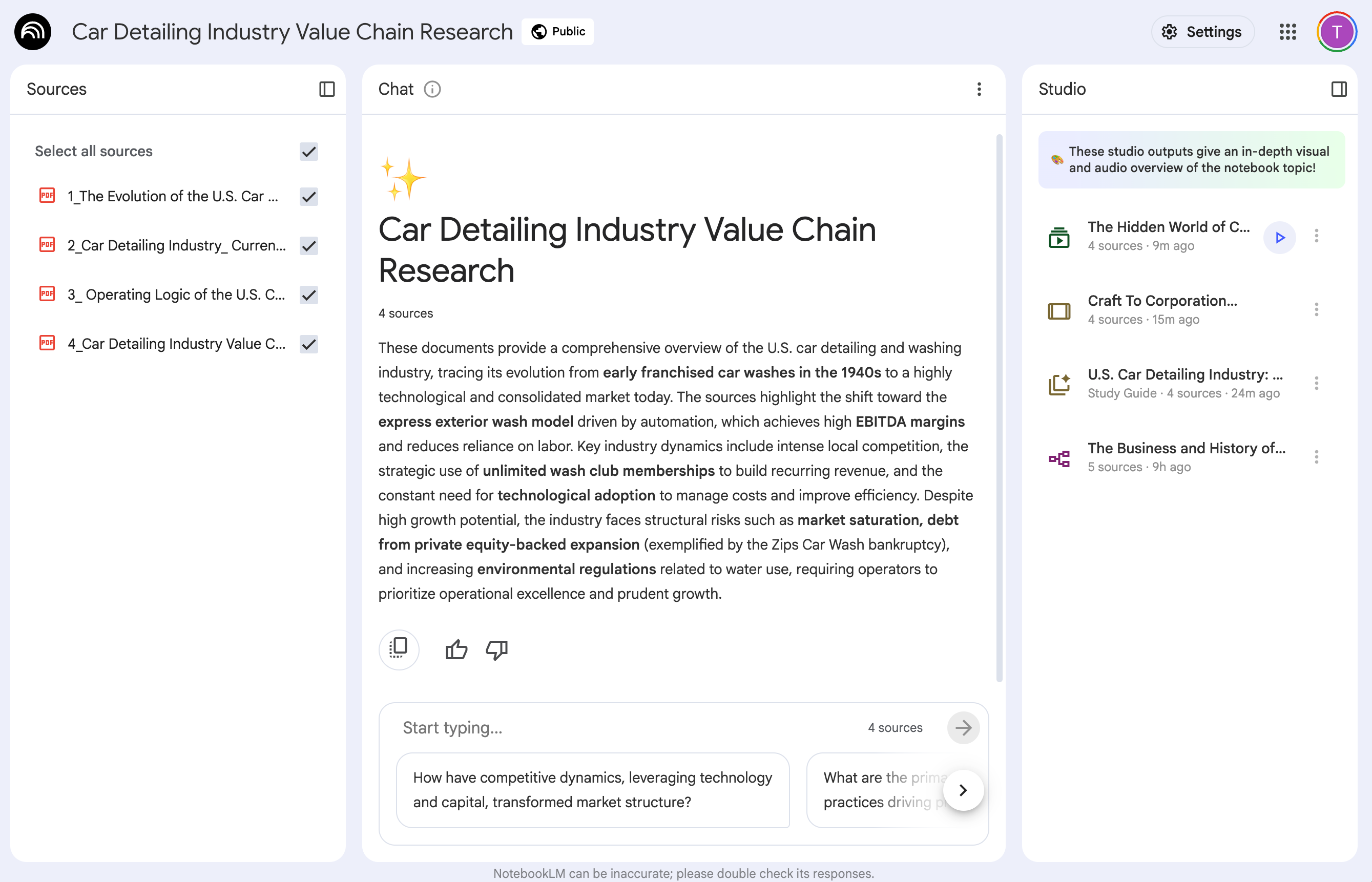
Go explore, ask questions in the chat related to the industry. In the Studio tab, there are some pretty cool materials totally generated by AI which are quite impressive, such as a 6-min video with great storytelling and graphics summarizing the findings from the research.
The slides are pretty good too! I think my favorite is the mindmap view, because it is interactive and you can review the content on your on pace and double click where you want to explore more.
Play around and let me know what you think. If you had already used, tell me some use cases you applied this technology to. I'll definitely be using more of this!
TBD out!
— Tobias